


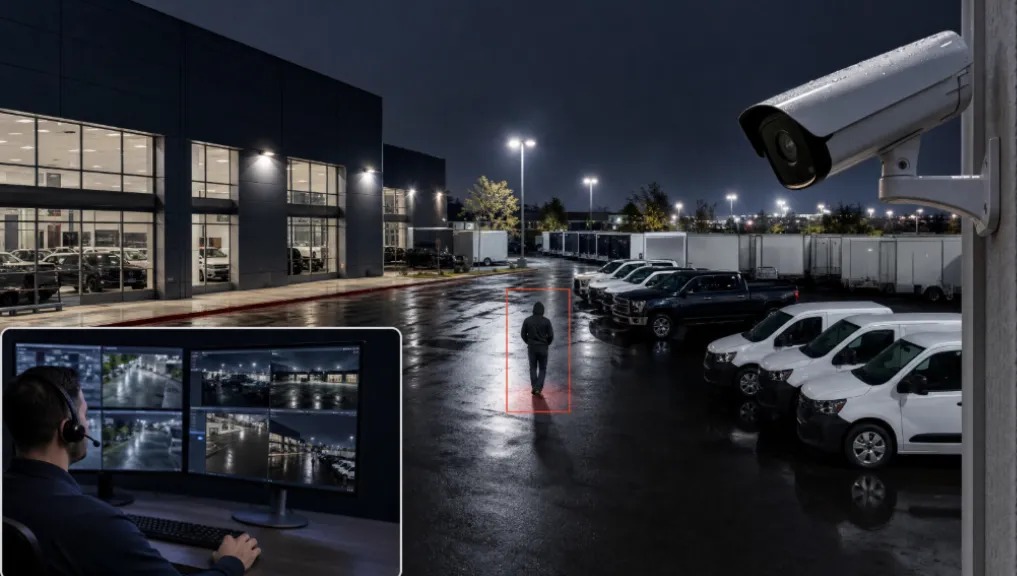
What Are AI Video Analytics?
AI video analytics are software tools that help cameras recognize certain types of activity. Instead of treating every motion event the same way, video surveillance analytics can be set up to flag specific behavior.
For example, an AI-assisted camera may flag a person walking through a dealership lot after hours, a vehicle entering a restricted area, someone crossing a perimeter line, or movement near a gate, loading dock, or construction site after crews have left.
The goal is simple: help the system find activity that may need human review.

What Can AI Security Cameras Help Detect?
AI security cameras and analytics can be configured around the property, the hours of concern, and the areas that matter most. Common examples include:
- A person entering an auto dealership lot after hours.
- A vehicle moving into a restricted or closed area.
- Someone crossing a fence line or perimeter.
- Loitering near a door, gate, loading dock, or parked vehicles.
- Movement near construction materials, equipment, or storage areas.
- Activity in areas that should be empty overnight.
This is useful because large properties can have dozens of cameras and several areas of concern. AI video analytics help bring attention to the events that may matter most.
Why AI Alone Is Not Enough
AI is helpful, but it is not perfect. It can flag activity, but it does not always understand context.
A shadow, animal, employee, delivery driver, weather event, or late-night maintenance visit may trigger an alert. That does not automatically mean there is a threat.
This is why human verification matters. Without a trained person reviewing the alert, a system can create noise instead of meaningful response.
Why Human Verification Matters
When an alert comes into a monitoring center, a trained operator reviews the live footage and asks basic but important questions:
-
Is this normal activity or suspicious activity?
-
Is the person supposed to be there?
-
Is the vehicle in an authorized area?
-
Does the situation need a live voice-down warning?
-
Does a manager, property contact, or emergency service need to be notified?
That review step helps with false alarm reduction and keeps the response appropriate. AI can point to the activity. A human operator decides what it means.

How AI and Human Operators Work Together
In remote security monitoring, the process should be simple and clear:
-
Detection: Cameras and AI video analytics identify activity that matches a rule, such as after-hours movement, line crossing, or loitering.
-
Alert routing: The alert is sent to the monitoring center in real time.
-
Operator review: A trained operator reviews the live video and checks the context.
-
Verification: The operator determines whether the activity is routine, suspicious, or urgent.
-
Response: If action is needed, the operator follows the property’s response protocol. This may include live voice-down audio, contact notification, documentation, or escalation when appropriate.
-
Documentation: The event is recorded so the property owner or manager has a clear record of what happened.

Where AI-Assisted Remote Video Monitoring Helps Most
AI-assisted remote video monitoring is especially useful for commercial properties that are exposed after hours or difficult to watch in person. This includes:
-
Auto dealerships with large vehicle lots.
-
Construction sites with tools, copper, equipment, and materials on site.
-
Warehouses and distribution centers with loading docks and access points.
-
Industrial properties with large perimeters.
-
Retail centers with parking lots, storefronts, and service areas.
-
Multifamily properties, HOAs, and gated communities.
-
Any commercial property where cameras are installed, but no one is actively responding after hours.
These properties often have the same problem: the riskiest hours are the hours when fewer people are on site. Remote video monitoring helps cover that gap.
How Virtual Guard Uses AI-Assisted Monitoring
Virtual Guard’s approach is built around three steps: Detect, Respond, Prevent.
Detect: AI-assisted alerts, camera rules, and monitoring technology help identify suspicious activity as it happens. Human operators then review the activity to confirm whether it needs a response.
Respond: When activity is verified as a concern, Virtual Guard’s trained operators follow the property’s response plan. That may include live voice-down audio, notifying designated contacts, documenting the event, or escalating when appropriate.
Prevent: The goal is not just to record what happened. The goal is to help deter trespassing, theft, vandalism, loitering, and unauthorized activity before it becomes a larger loss.
Common Misunderstandings About AI Security
AI does not replace human operators. It helps bring important activity to their attention faster.
AI does not make every decision. It flags activity. The operator verifies what is happening.
AI is not perfect. Lighting, weather, animals, and normal site activity can still create alerts.
AI without response is still limited. Detection matters, but response is what makes the system proactive.
The Smarter Way to Protect Commercial Properties After Hours
AI video analytics make security camera monitoring faster and more focused. Human operators make it useful by adding judgment, verification, and real-time response.
For commercial property security, the strongest approach is not choosing between technology and people. It is using both correctly.
If your property already has cameras but no one is actively reviewing alerts or responding after hours, your system may still be passive. Virtual Guard helps turn cameras into a proactive security tool through AI-assisted detection, human verification, and real-time response.
Schedule a Virtual Guard security assessment to see how AI-assisted remote video monitoring can support your property.
Learn More About Remote Video Monitoring
For a deeper understanding of how proactive video security protects properties, learn what Remote Video Monitoring is and how it works, including how trained security professionals can identify and respond to suspicious activity in real time. You can also discover why security cameras alone don’t prevent crime and why active monitoring can provide a stronger layer of protection. Explore Virtual Guard’s Remote Video Monitoring services to see how live surveillance and proactive intervention can help protect your property around the clock.
Frequently Asked Questions
What are AI video analytics in security?
AI video analytics are software tools that help security cameras identify certain types of activity, such as people entering restricted areas, vehicles crossing a boundary, loitering, or movement after hours. The analytics flag activity so a trained operator can review it.
Do AI security cameras replace human operators?
No. AI security cameras can help detect activity faster, but they do not replace trained human operators. A person still needs to review the alert, understand the context, and decide whether a response is needed.
Why is human verification important in remote video monitoring?
Human verification helps separate real concerns from false alarms. A trained operator can review live footage and determine whether the alert is routine, suspicious, or urgent.
What happens after AI detects suspicious activity?
The alert is sent to a monitoring center. An operator reviews the live footage, verifies the activity, and follows the property’s response protocol. That may include live voice-down audio, contact notification, documentation, or escalation when appropriate.
What types of properties benefit from AI-assisted remote monitoring?
AI-assisted remote monitoring is useful for auto dealerships, construction sites, warehouses, industrial properties, retail centers, multifamily properties, HOAs, gated communities, and other commercial properties with after-hours security concerns.


 Call Now