


Why Security Cameras Alone Don't Prevent Crime
Walk through almost any commercial property today and you will see cameras. Dealership lots, warehouse yards, retail centers, construction sites, multifamily properties, gated communities, and loading docks all rely on video surveillance in some form.
The issue is not that cameras are useless. Cameras are important. They create a record, support investigations, and help property owners understand what happened. The problem is that a camera by itself usually does not intervene.
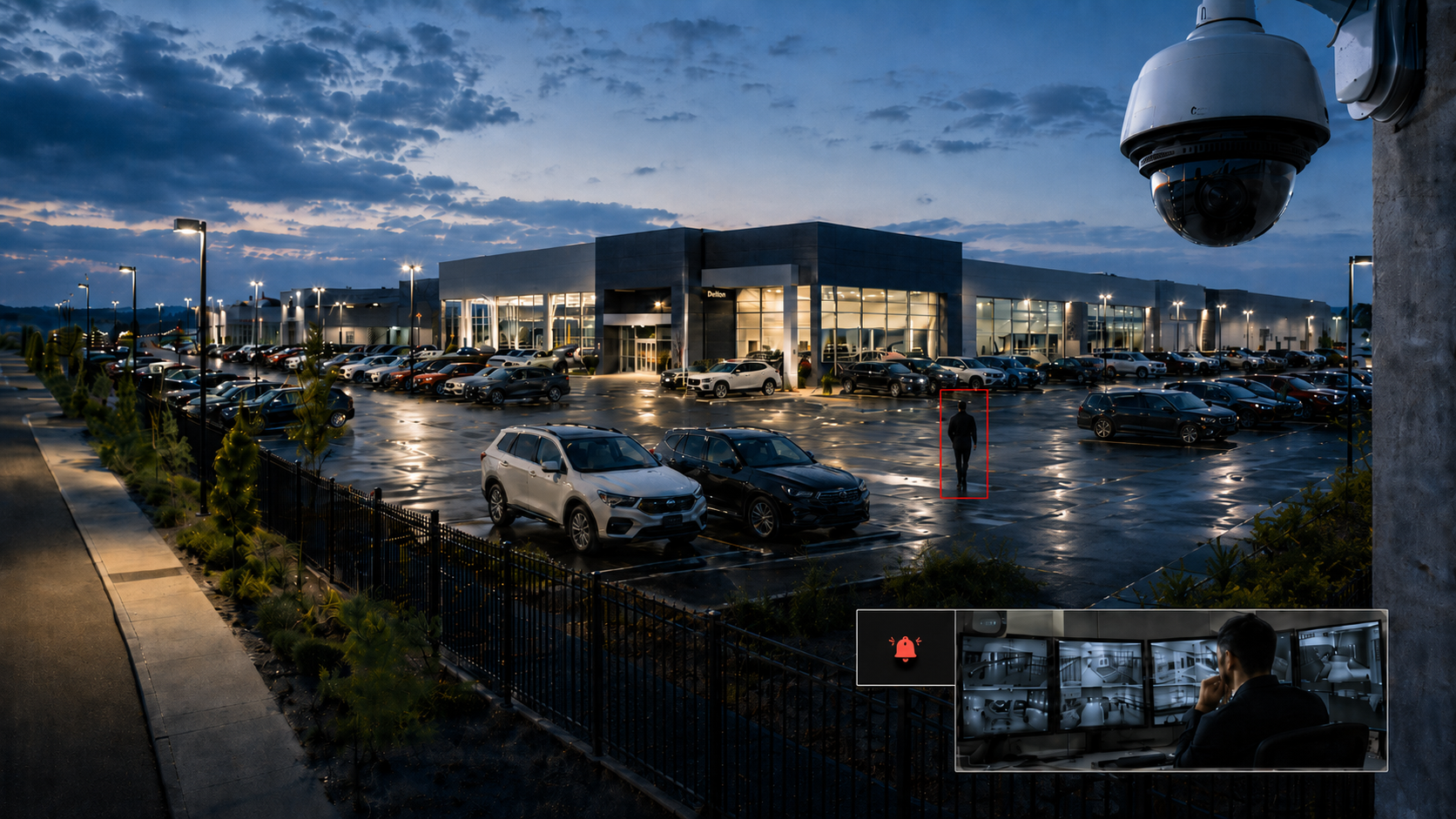
A camera can capture someone walking through a dealership lot at 2 a.m. It can record a gate being forced open. It can show a person moving between vehicles or entering a restricted area. But unless someone is watching and responding in real time, the footage may not be seen until the next morning.
By then, the damage may already be done.
Recording Crime vs. Preventing Crime
Standard security cameras are strongest after an incident. They provide footage for investigations, insurance claims, police reports, and internal review. That matters, especially when a property owner needs proof of what happened.
But recording is not the same as prevention. A clear video of someone stealing equipment does not stop the equipment from being stolen. Footage of vandalism does not repair the damage. A time stamp does not change the outcome if no one was there to respond.
Prevention requires a different kind of system. It requires the ability to detect suspicious activity, verify whether it is a real concern, and respond while there is still time to change the outcome.

Passive Security vs. Proactive Security
Passive security collects information. A camera records. A motion alert is saved. Footage is stored for someone to review later.
That information has value, but passive systems put property owners in a reactive position. You find out what happened after it happened. Then you deal with the loss, paperwork, repairs, insurance process, and operational disruption.
Proactive security is different. It combines cameras, alerts, human verification, response protocols, and documentation so suspicious activity can be addressed while it is happening. The goal is not just to know what happened. The goal is to reduce the chance that the incident becomes a loss.
How Virtual Guard Uses Detect, Respond, Prevent

Detect: Identify Suspicious Activity in Real Time
Detection starts with the right camera coverage, analytics, and alert systems. Activity near a gate, perimeter, loading dock, vehicle lot, equipment area, or building entrance can be flagged for review.
Technology helps surface the activity, but human verification matters. Not every alert is a threat. A shadow, an employee working late, a delivery driver, or normal after-hours activity can trigger a system. Trained operators review what is actually happening so the response is appropriate.
Respond: Take Action While It Is Happening
When suspicious activity is verified, the response can begin immediately. One of the most direct tools is live voice-down audio. A trained operator can speak to the person on the property through an integrated speaker system and make it clear that the property is actively monitored.
That changes the situation. The person is no longer moving through an empty property with only cameras watching. They know someone has seen them and is responding in real time.
Depending on the property and the event, response may also include notifying designated contacts, following a custom escalation protocol, contacting law enforcement when warranted, and documenting the incident.
Prevent: Reduce Loss Before It Happens
Prevention is the larger goal. Virtual Guard is not there simply to collect footage of incidents. The goal is to help deter trespassing, theft, vandalism, loitering, unauthorized access, and after-hours activity before damage is done.
No security solution can eliminate every threat. What proactive monitoring can do is make the property a harder target. When suspicious activity is met with a real response, the risk profile of the property changes.
Real-World Example: Auto Dealership After Hours
Picture a dealership lot at night. A person enters the property and starts walking between vehicles. With a standard camera system, the activity is recorded. If something happens, the footage may help show when the person arrived, where they walked, and what vehicle or area was targeted.
With active remote video monitoring, the sequence can look different. The activity is flagged. An operator reviews the camera feed, verifies that the behavior looks suspicious, and issues a live voice-down warning. The person is addressed directly and told the property is under active surveillance.
If the person leaves, the incident can be documented without a larger loss. If the activity continues, the operator follows the response protocol, which may include notifying the property contact or escalating to law enforcement.
The cameras may be the same. The difference is that someone is watching and ready to act.
Where Else Remote Monitoring Helps
The same principle applies beyond auto dealerships. Construction sites often have expensive equipment, tools, materials, and copper wiring exposed after hours. Warehouses and industrial properties may have loading docks, access points, and large perimeters that are difficult to watch continuously. Retail centers may deal with loitering, vandalism, and storefront activity after closing.
HOAs, gated communities, and multifamily properties may have recurring issues with unauthorized entry, gate access, parking areas, amenity spaces, or package theft. In each case, the core question is the same: when the camera sees something, does anything happen?
Remote video monitoring helps answer that question with a real-time process instead of a next-day review.
Why Human Verification Matters
AI-assisted analytics and motion alerts can be useful, but they are not enough on their own. Automated systems can generate false positives. Alerts can pile up. A system that flags everything without meaningful review quickly becomes noise.
Human verification adds judgment. A trained operator can look at the camera feed, consider the context, and determine whether the activity needs a response. That makes monitoring more practical, more accurate, and less likely to waste time on normal activity.
The strongest systems use technology to surface activity and trained people to verify what is happening.

Cameras Still Matter - They Just Need a Response Layer
This is not an argument against cameras. Cameras are the foundation of modern property security. Without the right camera coverage, operators cannot see the property clearly, review activity, or document events properly.
The point is that cameras become more valuable when they are connected to a response system. A camera that records footage for later review is useful. A camera that helps trigger real-time monitoring, voice-down audio, escalation, and documentation is stronger.
The limitation is not the camera. The limitation is what happens after the camera sees something.
Questions Property Owners Should Ask
If your property already has cameras but incidents are still happening, ask these questions:
Is anyone watching the cameras after hours?
What happens when someone enters the property at night?
Do alerts go to a trained operator, or do they sit until someone reviews them later?
Is there a clear response protocol for suspicious activity?
Are you trying to document crime, prevent it, or both?
These questions help reveal whether your current system is built for documentation or for intervention. Both matter, but prevention requires action.
Move From Passive Cameras to Proactive Security
Security cameras are important, but they are only one part of a stronger security strategy. If cameras are recording but no one is responding, the system is still passive.
Virtual Guard helps businesses move from passive recording to proactive protection through Detect, Respond, Prevent. We help identify suspicious activity in real time, respond while the event is still happening, and work to prevent losses before they escalate.
If your property is dealing with theft, trespassing, vandalism, loitering, unauthorized access, or after-hours activity, contact Virtual Guard to schedule a security assessment and learn how remote video monitoring can work for your site.


 Call Now